Embodying excellence: three Constructor University students win 2026 Bremen Thesis Prize
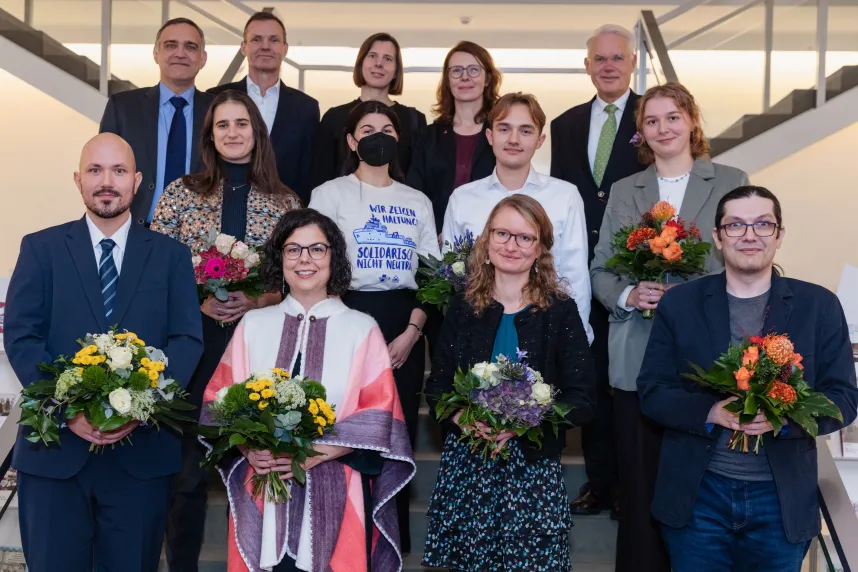
Three researchers from Constructor University have been awarded the 2026 Bremer Studienpreis (Bremen Thesis Prize) in recognition of their exceptional academic contributions at the Master’s and PhD levels. Dr. Cristina Greculescu, Dr. Anna-Lena Zocher and Catalin Toma were presented with the prize alongside laudations from their supervising professors at a ceremony held November 24 at the Bremen Parliament (Bremische Bürgerschaft).
The prize has been awarded annually since 1983 by Unifreunde – a joint initiative between the University of Bremen and Constructor University to recognize innovative research and emerging talent from the region’s universities. It includes an endowment of €1,000 for PhD dissertations and €500 for Master's theses. Learn more about the Bremen Thesis Award here.
The ceremony was attended by university leadership as well as representatives from the Bremen government and industry to honor the excellence, diversity and impact of research produced by the region's top up-and-coming researchers.
"One of the great strengths of Bremen is the richness and diversity of its educational and scientific landscape," said Constructor University Dr. Frazer Cairns in his address at the ceremony. "It is an environment in which ideas can move relatively easily between disciplines, institutions, fundamental research and practical application. While our community at Constructor University is international, our institutional identity is firmly rooted in Bremen, and we feel enormously privileged to be part of this ecosystem."
Dr. Cristina Greculescu received the "Thematic Prize"—awarded to an outstanding thesis that showcases cooperation and collaboration between the University of Bremen and Constructor University—for her PhD dissertation in educational psychology, “Teaching Grit: Examining the effects of a school-based intervention to foster grit."
Catalin Toma was honored for his computer science and software engineering Master's thesis “PiQuant: Modeling Quantum Computing with π-calculus.”
Dr. Anna-Lena Zocher received the prize for her PhD dissertation in the field of geochemistry, “Rare Earth Elements in the Environment and Their Transfer Across the Hydrosphere-Biosphere Interface: Examples from Freshwater and Marine Systems.”
Dr. Cristina Greculescu: a study in grit
Dr. Cristina Greculescu first moved to Bremen from Romania in 2003 to attend the International University Bremen (now Constructor), where she would go on to complete both her undergraduate and Master's studies and hold several staff positions along the way. "Altogether, I've spent over 20 years at Constructor University, which I look back on with a strong sense of belonging and gratitude," noted Dr. Greculescu.
"On a personal level, it feels particularly special to receive the Bremer Studienpreis for research on perseverance after my own doctoral journey required so much of it. I completed most of my research while working at the university, with some very difficult periods in life along the way. In that sense, grit was not only the subject of my research but also something I needed to see it through."
Professor of Social Science Methodology Klaus Boehnke, who supervised Dr. Greculescu's PhD at BIGSSS together with Yasemin Karakaşoğlu, Professor for Intercultural Education at the University of Bremen, has been part of her academic journey from day one and echoed the sentiment. "Cristina wrote her dissertation on the topic of grit, or 'Biss' as we say in German, and that pretty much says it all," said Prof. Boehnke. "I've known Cristina since she began her bachelor’s degree and have watched her progress through her master’s program and doctoral studies. It was not always an easy journey, but Cristina has always pursued her goals successfully and with tenacity, all while raising two children." .
Greculescu's research explored whether and how to foster "grit," broadly defined as passion and perseverance for long-term goals, among adolescents in the school context. She worked closely with students and teachers at two local schools (Oberschule Gröpelingen and Gesamtschule Bremen-Ost) to develop and implement a digital intervention designed to help students adopt a growth mindset, find meaning in their education, set goals, and learn practical strategies for overcoming obstacles and setbacks.
"I was particularly interested in whether such an intervention could help mitigate educational inequalities," reflected Dr. Greculescu. "In Germany, students’ educational opportunities still depend heavily on their social backgrounds. While psychological interventions can't eliminate structural disadvantages, they may still improve student outcomes within the limitations posed by inequitable access to resources."
Dr. Greculescu hopes to extend the tool's reach and impact beyond academia by making it accessible to schools and teachers. "I hope to collaborate with educational institutions and policymakers to bring these approaches into everyday classroom practice, starting right here in Bremen, my adopted hometown," she said.
Catalin Toma: bridging quantum and computer science
Catalin Toma, also from Romania, completed both a Bachelor's degree in physics and a Master's degree in mathematics at Constructor University before returning to take the Computer Science and Software Engineering Master's program. "I was very interested in quantum computing and quantum software engineering, and my mixed STEM background helped a lot when it came to bridging the gap between computer science and physics for this project," said Toma. “Quantum computing can be difficult for computer scientists to work with because it is full of mathematical formulas that have no intuitive meaning related to the problem that the code solves.”
The PiQuant framework that Toma developed for his Master’s thesis helps make quantum computing more approachable for software engineers by adapting a well-established computer science framework called 𝜋-calculus to quantum variables and principles. “The goal is to ultimately make quantum computing more palatable for computer scientists, and to get more people developing software for quantum computers as they become more widely accessible and available,” said Toma.
Toma's supervisor, Prof. Dr. Manuel Oriol, commended Toma for the courage and innovation behind his research. "Quantum computing has a reputation: brilliant physics wrapped in mathematics that most software engineers find impenetrable, but Catalin's Master's thesis set out to change that. His idea is as elegant as it is bold: treat a quantum program not as a sequence of matrix operations, but as a concurrent system. This is work that bridges two worlds with rigor and courage," he said.
Toma is grateful for both the recognition that the prize brings to his work on PiQuant, as well as the career and academic doors it may help open. "It was a fun challenge and a rewarding experience. I'm very grateful to all the wonderful people at Constructor whose support and guidance helped make it possible," said Toma, thanking his supervisor Prof. Oriol and second reader Prof. Wolfgang Tittel, as well as Dr. Bertrand Meyer, Dr. Mauro Pezze, Dr. Flavia Trifa and Johanna Elo-Schäfer.
Dr. Anna-Lena Zocher: bringing rare earth elements into focus
Dr. Anna-Lena Zocher first chose to study geosciences at Constructor University (then Jacobs) as a way to combine her mutual interest in environmental and natural sciences. During her undergraduate years, she found herself drawn to environmental geochemistry both by her fascination with the field itself as well as the welcoming atmosphere of the university's geochemistry research groups. Both factors would inspire her to eventually return to Constructor University to complete her PhD with Professor Dr. Michael Bau's Geochemistry—Geosciences research group after getting her Master's degree from the Luleå University of Technology in northern Sweden.
Dr. Zocher's research focuses on the distribution and behavior of rare earth elements in water, sediments and organisms, a topic of growing importance given their increasing presence in both human and natural systems. "Because rare earth elements are essential to numerous high-tech products and processes, they are being released into the environment at increasing rates," explained Dr. Zocher, "but our understanding of their behavior and impact is still limited. I want to help close this knowledge gap with my research."
Prof. Dr. Bau lauded Dr. Zocher for the strength of her work on a topic that has become a focal point in both geopolitical and media discourses. "Dr. Zocher's studies have significantly expanded our understanding of how these substances behave in the environment, and I am confident that she will continue to enrich our knowledge in this field—an area of great importance to both the economy and the scientific community in Bremen," said Prof. Dr. Bau.
"It is a great honor to receive the Bremer Studienpreis from Unifreunde, said Dr. Zocher. "It's a prize that values the research of both universities in the city of Bremen, and of course, it motivates me to continue research in this field."
Constructor University extends its heartfelt congratulations to all three recipients and wishes them sustained success in their future endeavors.
Receive all updates straight to your inbox.