PhD student Niclas Führling wins Best Student Paper Award at IEEE Conference on Integrated Sensing and Communications (ISAC)
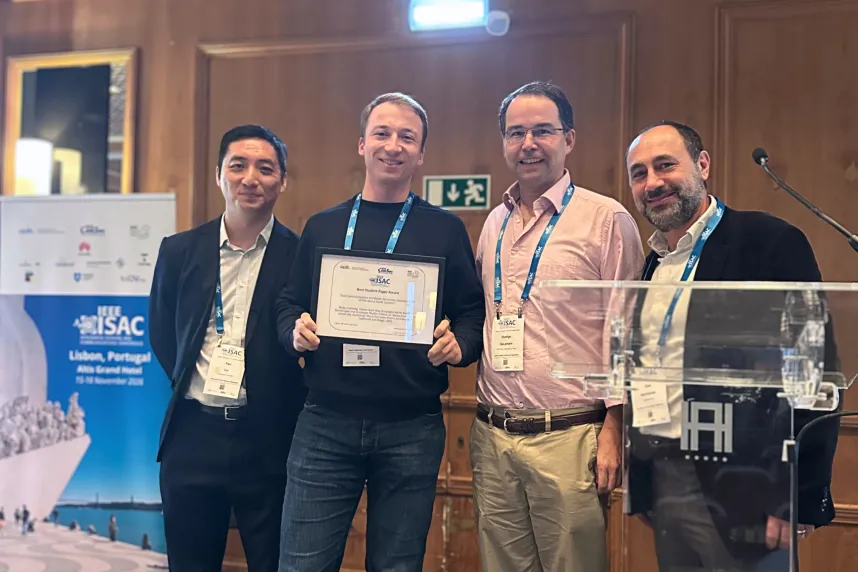
Could the wireless networks that connect our devices one day help autonomous vehicles and other machines sense and navigate the world around them? This is a core objective of 6G wireless systems, and the research topic of Constructor University PhD student Niclas Führling that won the Best Student Paper Award at the inaugural IEEE Conference on Integrated Sensing and Communications (ISAC). The conference, which took place November 15-18 in Lisbon, Portugal, was the first large-scale event dedicated to ISAC and its applications.
ISAC technology uses wireless signals not only for communication, but for environmental sensing, meaning it can provide information about the location, distance and movement of objects. Its development represents part of a broader effort to develop what researchers call Physical AI: artificial intelligence capable of perceiving and understanding the physical world around it. The research of Führling and his PhD supervisor, Professor of Electrical Engineering Guiseppe Abreu, focuses on a major challenge within ISAC: how to calibrate multiple network stations to work together to accurately detect and track objects in their surroundings.
"Think about how hundreds of people can stream across a crowded, urban intersection without constantly bumping into one another. It’s an innate ability for humans, and even simple living organisms, that remains remarkably challenging for robots, even those running sophisticated AI models," explained Prof. Abreu. "The challenge isn’t necessarily intelligence in the conventional sense, but what we call ‘physical intelligence’: the ability to perceive and respond to our surroundings in real time."
The key to unlocking this capability is precision: for ISAC to function in dynamic environments where a momentary gap in perception could cause serious consequences, network stations must be precisely synchronized. Even tiny differences in the timing and frequency of a signal could interfere with the system's ability to distinguish between actual movement in the environment and discrepancies caused by the equipment itself.
This is the challenge Führling and his colleagues have tackled in the award-winning paper, "Joint Synchronization and Radar Parameter Estimation for OFDM-based DISAC Systems." Rather than treating synchronization as a separate, preliminary challenge to be resolved prior to object detection, the paper proposes a mathematical algorithm that enables the system to estimate synchronization differences between network stations while simultaneously detecting the distance and velocity of objects. Führling and his colleagues ran computer simulations to demonstrate the algorithm’s accuracy against established benchmarks.
For Führling, the award offers meaningful validation both individually, and for the work of Constructor University’s Communication and Signal Processing research group. “Receiving the Best Student Paper Award was an unexpected and profound honor for me and our entire research group,” he said.
“We’re grateful to the IEEE as the world’s largest technical professional organization for organizing a conference fully dedicated to ISAC. The number and caliber of leading researchers who took part in this inaugural event shows just how important the topic is to our field, and adds to the significance of the award.”
Visit Constructor University’s School of Computer Science & Engineering webpage to learn more about our research and study programs.
Receive all updates straight to your inbox.