Sustainable and Resilient Operations Management

The Sustainable and Resilient Operations Management (SROM) group develops optimization and AI-enabled decision-support methods for complex industrial, logistics, and service systems. Our research combines mathematical programming, metaheuristics, data-driven methods, and explainable AI to improve operational performance while explicitly addressing sustainability, energy use, uncertainty, and disruption resilience.
The group builds on a long-standing research program in scheduling and resource coordination, originating in automated container-terminal operations and expanding to manufacturing, intralogistics, supply chains, and energy-aware operations. A central objective is to make advanced optimization methods not only computationally effective, but also interpretable and useful for real decision makers.
- Advanced optimization and scheduling: Mathematical programming and metaheuristics for complex scheduling, resource-allocation, and coordination problems in manufacturing, logistics, and transportation systems, including integrated machine-transport scheduling and seaport operations.
- Sustainable and energy-aware operations: Multi-objective and energy-aware models that jointly consider operational performance, energy consumption, peak power, renewable-energy availability, and environmental objectives.
- Resilient supply chains and operations: Risk-aware and stochastic planning methods for systems exposed to disruptions and uncertainty, including forest-to-bioenergy supply chains under wildfire risk and resilient logistics networks.
- AI and explainable AI for Operations Research: Machine-learning and XAI methods that support optimization through structure discovery, surrogate modelling, search guidance, and post-optimization explanations. Current work investigates how explainability can improve both algorithmic performance and decision-maker understanding.
- Application domains: Manufacturing systems, internal logistics, seaports and container terminals, supply chains, bioenergy systems, and other resource-constrained industrial and service operations.
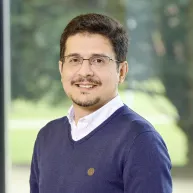
Dr. S. Mahdi Homayouni, Senior Lecturer in Industrial Engineering and Management, School of Business, Social and Decision Sciences, Constructor University.
The group involves three doctoral researchers, and Bachelor’s and Master’s students working on optimization, scheduling, sustainable and resilient operations, and AI-enabled decision support.
- Homayouni, S. M. (2026). Power flexible scheduling of quay cranes and automated guided vehicles in container terminals. In International Conference on Logistics and Maritime Systems (pp. 40-50). Cham: Springer Nature Switzerland.
- Gomes, R. L., Neves-Moreira, F., Soares, R. F. F., Amorim, P. S., & Homayouni, S. M. (2026). Risk-aware planning of forest-to-bioenergy supply chains under wildfire disturbance. Trees, Forests and People, 101237.
- Homayouni, S. M., Pinho de Sousa, J., & Moreira Marques, C. (2025). Unlocking the potential of digital twins to achieve sustainability in seaports: the state of practice and future outlook. WMU Journal of Maritime Affairs, 24, 59–98.
- Fontes, D. B. M. M., Homayouni, S. M., & Fernandes, J. C. (2024). Energy-efficient job shop scheduling problem with transport resources considering speed adjustable resources. International Journal of Production Research, 62(3), 867–890.
- Fontes, D. B. M. M., Homayouni, S. M., & Gonçalves, J. F. (2023). A hybrid particle swarm optimization and simulated annealing algorithm for the job shop scheduling problem with transport resources. European Journal of Operational Research, 306(3), 1140–1157.
- Homayouni, S. M., Fontes, D. B. M. M., & Gonçalves, J. F. (2023). A multistart biased random key genetic algorithm for the flexible job shop scheduling problem with transportation. International Transactions in Operational Research, 30(2), 688–716.
- Homayouni, S. M., & Fontes, D. B. M. M. (2018). Metaheuristics for Maritime Operations. ISTE / Wiley.
- Homayouni, S. M., & Tang, S. H. (2016). Optimization of integrated scheduling of handling and storage operations at automated container terminals. WMU Journal of Maritime Affairs, 15, 17–39.
- Homayouni, S. M., & Tang, S. H. (2013). Multi objective optimization of coordinated scheduling of cranes and vehicles at container terminals. Mathematical Problems in Engineering, 2013.
The SROM research agenda reflects a continuous development from optimization of tightly coupled operational systems toward broader questions of sustainable, resilient, and intelligent operations. Since the early work on integrated equipment scheduling in automated container terminals, the research has expanded to advanced manufacturing scheduling, transportation-aware production systems, energy-efficient operations, disruption-aware supply chains, digital twins, predictive maintenance, and AI/XAI-assisted optimization.
The group welcomes interdisciplinary and industry-oriented collaboration where rigorous Operations Research can be combined with data and artificial intelligence to support transparent, robust, and implementable decisions. Undergraduate and graduate students can contribute through research projects, theses, computational experiments, data analysis, literature reviews, and development of optimization and AI prototypes.