Sir Konstantin Novoselov discusses high-risk research and the future of universities at Falling Walls Science Summit in Berlin
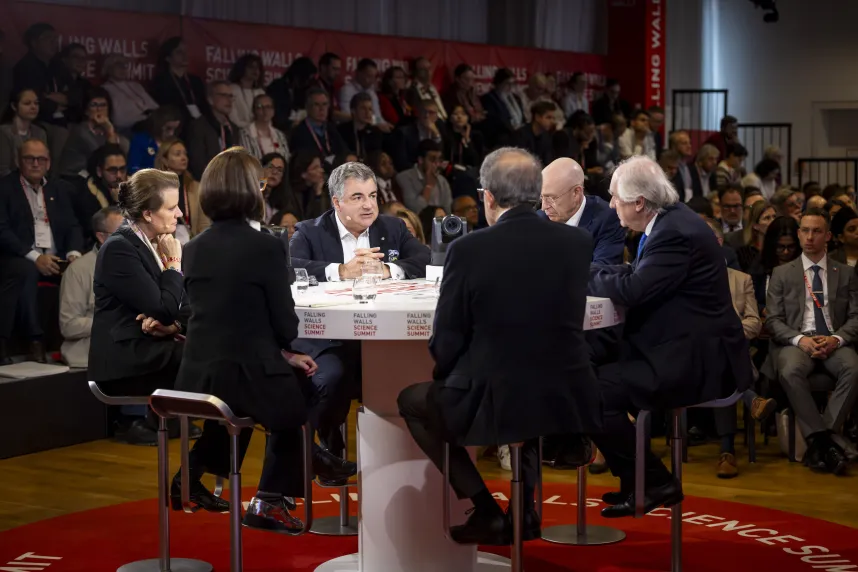
How can research funding support bold ideas at the frontiers of science before their impact is clear, and how will AI reshape the role of the university? These were some of the themes that Constructor University Sir Konstantin Novoselov’s addressed at the Falling Walls Science Summit held November 7 in Berlin. The Nobel prize laureate and president of Constructor University took part in an international panel on funding high-risk, high-reward scientific research, as well as a fireside chat on the future of universities in the age of artificial intelligence (AI).
The fireside chat, a highlight of the summit, was moderated by science journalist Christina Sartori and recorded for Table.Media daily podcast. In the conversation, Prof. Sir Novoselov discussed how AI is changing the role of universities and the skills students will need in the future. He emphasized the continuing importance of human judgment, creativity and the ability to translate ideas into real-world impact.
“When AI can teach what is already known, a university’s role is to discover what isn’t and put it to work,” said Prof. Sir Novoselov. “At Constructor University, we make researchers and students more efficient and connect them to the Constructor Group, an academic flywheel that links knowledge, research, technology and industry. This ecosystem is attracting companies and investors who in turn help transform scientific breakthroughs into real-world impact.”
Prof. Sir Novoselov went on to explain how this kind of ecosystem model gives students and researchers greater opportunities to work with advanced technologies and develop innovative ideas while also creating connections and collaborating with partners beyond the university.
“Universities should prioritize what AI can’t replace: judgment, creativity and the ability to turn ideas into impact,” said Prof. Sir Novoselov. “Our students build these skills by working efficiently with AI and through connections to the Constructor Group, industry partners and investors who put their work to use.”
Prof. Sir Novoselov also participated in the HFSPO Plenary Table, “From Risk to Discovery: Reimagining Research Funding for Frontier Science.” The discussion examined how funding agencies can support unconventional and interdisciplinary research while maintaining rigor, accountability and responsible oversight.
The panel considered how funders can build portfolios that tolerate risk, evaluate ideas that do not fit established categories and give promising but uncertain research the opportunity to succeed. Participants also discussed how geopolitical tensions, research security concerns and changing conditions for international collaboration were affecting the future of frontier science.
Prof. Sir Novoselov is a renowned condensed matter physicist and the President of Constructor University since February, 2025. Together with Andre Geim, he was awarded the 2010 Nobel Prize in Physics for their work in isolating graphene at the University of Manchester in 2004.
Receive all updates straight to your inbox.