25 years of Constructors: Jana Hofmann - the Luminary
In honor of Constructor University's 25th anniversary, we're featuring alumni from past graduating classes to showcase the diversity, values and impact that Constructor graduates have carried into the world. You can check out all the alumni interviews from the series on our 25th Anniversary web page.
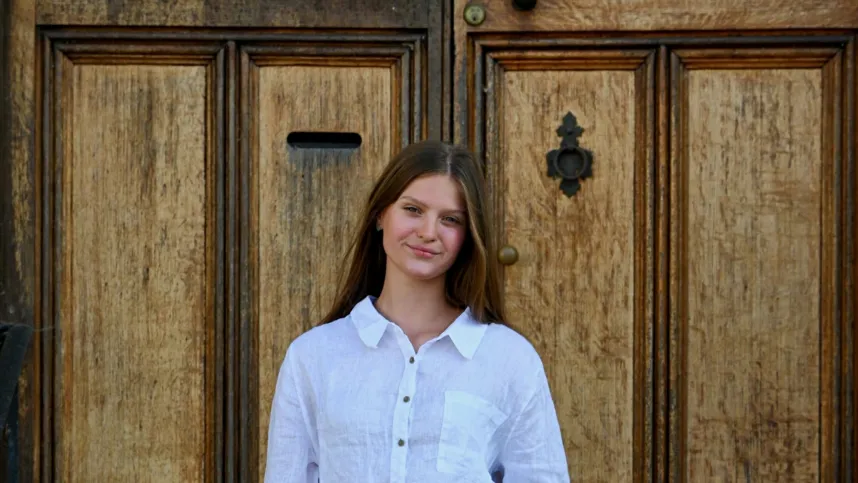
This week, from the Class of 2024, we spoke with Jana Hofmann, who is currently completing a PhD in Physics at Cambridge University. Through her work in nanophotonics, Jana is harnessing the unique properties of light at the nanoscale to help advance crucial technologies like medical diagnostics. Beyond the laboratory, her passion for discovery and for effecting positive change has led to meetings with world leaders and Nobel laureates.
In our illuminating conversation, Jana reflects on the power of pursuing interesting things, why helping people matters, and what Angela Merkel taught her about hope.
QUICK FACTS:
- Graduation Year: 2024
- Major: Physics
- College: Nordmetall
- An unforgettable campus memory: my first day of undergrad: having a bonfire with people I’d just met, then going to the interfaith house where a group gathered to listen to my friend practice violin before joining on piano and singing our favourite songs together. Those people have been close friends ever since.
- On Saturday night, you’d most likely find me: Having a jam session or hanging out with friends
- Favorite on-campus snack: Avocado sandwich with a caramel cappuccino from the coffee bar
- My proudest moment: Organizing JacobsHack together with great people
As part of our 25th anniversary, we’re exploring the theme of decision-making. What are some key decisions that helped shape the course of your own life?
The decision that had the biggest impact on me was simply choosing to try everything that sounded interesting. If I ended up not enjoying something, I could always drop it so I wouldn't overload my schedule, but this approach gave me the freedom to discover new things that I actually enjoyed, and gain a wider perspective on life.
Can you share an example of putting that philosophy into practice and how it paid off?
Deciding to study abroad for a semester was a big one. I had never been to China or anywhere in Asia before my semester abroad, and it was one of the most eye-opening experiences I’ve ever had! It expanded my whole mindset about what was possible for my future.
Organizing JacobsHack in 2022 was very similar. Having zero prior experience running an event of that scale and jumping straight into the deep end became a general pattern for me. I realized that the decision to eagerly take on whatever came my way is what opened the door to so many amazing opportunities. Whether it was my internship in Tromsø or finding exciting research projects, I learned that if you never ask or never try, you’ll never get the chance. People are often surprisingly keen to help you succeed if you just talk to them about your goals.
Being from Germany, you know firsthand how unique Constructor University is as a private, international, English-speaking university. What drew you to study here and how did the distinct learning environment shape your experience compared to attending a public German university?
For one, the ability to study physics in English was a huge plus for me, especially because I already knew that I wanted to go somewhere international for further education. Since most postgraduate programs and scientific communications are in English, learning all the terminology in English from day one made transitioning into an international research environment much smoother than if I had studied in German.
The campus setting also made a massive difference when compared to a typical German city university. Having everything in one place let me develop deeper friendships and meant no time was wasted commuting. It left me with so much more free time for hobbies and extracurriculars alongside my lectures and laboratory courses. You could be working in the lab one hour, and dancing with your friends in Campus Crew one two-minute walk later.
Being in such an international environment forces you out of your comfort zone and expands your bubble. Constantly navigating cultural differences made me far more resilient than I think I would have become at a public German university. Finally, the small class sizes meant having close, personalised contact with professors, which made it easy to discuss my options and reflect early on about what I wanted to pursue next.
As a recent grad looking at today’s global challenges and opportunities, what kind of impact or value do you think Constructor University graduates are best positioned to bring to the world? Thinking ahead to the next 25 years, what do you think Constructor University's legacy could be?
Constructor graduates bring a unique ability to adapt and connect with people from completely different backgrounds. Having collaborated in a tight-knit, international environment where everyone approaches problems from different angles, we are well-positioned to bridge the gap between technical fields and real-world needs.
Over the next 25 years, I believe Constructor’s legacy will be a global network of open-minded, resilient problem-solvers who aren't afraid to step outside their comfort zone to tackle complex issues together.
You are currently a PhD researcher at Cambridge University specializing in nanophotonics, plasmonics, and optical sensing. How did you find your passion for this field?
I always knew that I ultimately wanted to help people through my work. After high school, I considered studying medicine, but I ended up choosing physics because it kept more doors open and didn't lock me into a single path too early.
When looking for my mandatory internship between second and third year, I wanted to experience hands-on research and stumbled onto optical sensing: specifically, using light to measure extracellular vesicles to evaluate the risk of thromboembolism [editor’s note: a condition in which a blood clot (thrombus) breaks off from its original site and travels through the bloodstream] in patients.
Realizing that I could apply physics to medical diagnostics to directly help people was the turning point for me. During that internship in Tromsø, conversations with fellow researchers introduced me to the work being done in Cambridge on non-invasive sensing for health monitoring. After completing my undergraduate thesis on Raman and time-resolved spectroscopy of solar cells with Prof. Arnulf Materny, I had built up the confidence and expertise to apply. I went on to complete my Master's at the NanoPhotonics centre in Prof. Jeremy Baumberg's group at the University of Cambridge and enjoyed it so much that I decided to stay on for my PhD.
You seem drawn not only to the science itself, but to where it intersects with real-world use and impact. Which applications do you find most compelling?
Yes! What excites me the most about nanophotonics and optical sensing is that it isn’t restricted to academic research; there are already so many real-world companies and applications built on this technology.
Early diagnostics is definitely the most compelling area for me, as being able to catch subtle health markers early directly fulfils my goal of wanting to help people. The exact same underlying physics can also be applied to other fields, such as monitoring trace pollutants to protect animal health and the environment in agriculture or detecting chemical signatures to check for drugs and doping in sports. Taking concepts from physics, chemistry, and materials science to build tools that solve these kinds of practical problems is what keeps me motivated.
Outside of the lab, you're highly engaged in volunteer and other engagements, like serving as President of the Cambridge University German Society. What do these activities contribute to your personal and professional growth?
I view these roles as a way to stay grounded, connect with people, and build skills outside of pure lab work. They give me a broader perspective on how science fits into the wider world. They also sharpen my resilience and public-facing communication, which directly feeds back into making me a more confident researcher and person in general.
This work has also led to some incredible opportunities, like meeting with former German Chancellor Angela Merkel and interviewing Nobel Physics Laureate Anne L'Huillier. Any insights can you can share from these moments?
One standout moment was listening to Angela Merkel, whose main message was to stay hopeful, always. Her point was simple: if you don't have hope for a better world or a better future, it won't happen. Another memorable conversation was with Nobel Laureate Anne L'Huillier, who emphasised the importance of staying resilient and deeply curious about your work, even when progress is slow.
On a broader level, the biggest insight has been getting to see the human side of how these individuals got to where they are, understanding the decisions that shaped their paths and why they made them during pivotal moments. Conversations like these broaden my horizons on what's possible and gives me a much clearer sense of how top leaders think and navigate their careers.
How do you balance all your activities in and outside of academics, and what advice would you share for effectively managing one’s time and energy across many endeavors?
When it comes to managing time and energy, my main tip is to give yourself permission to try things out, but also to be willing to step back and stop if you realise you don't enjoy something or if it's overloading your schedule. Making space for things you're genuinely curious about actually gives you energy rather than draining it, as long as you stay mindful of your boundaries and don't let your calendar run you. Intentional context-switching and prioritizing what recharges you are the key here.
Sounds like great advice. Thank you so much for making time for us Jana!
Receive all updates straight to your inbox.