25 years of Constructors: Hashem Al-Ghaili – the Influencer
In honor of Constructor University's 25th anniversary, we're featuring alumni from past graduating classes to showcase the diversity, values and impact that Constructor graduates have carried into the world. Check out our previous features:
- Class of 2004: Aakash Jain
- Class of 2005: Neil D’Souza
- Class of 2006: Joanna Bagniewska
- Class of 2007: Dr. Binyam Mogessie
- Class of 2017: Arka Halder
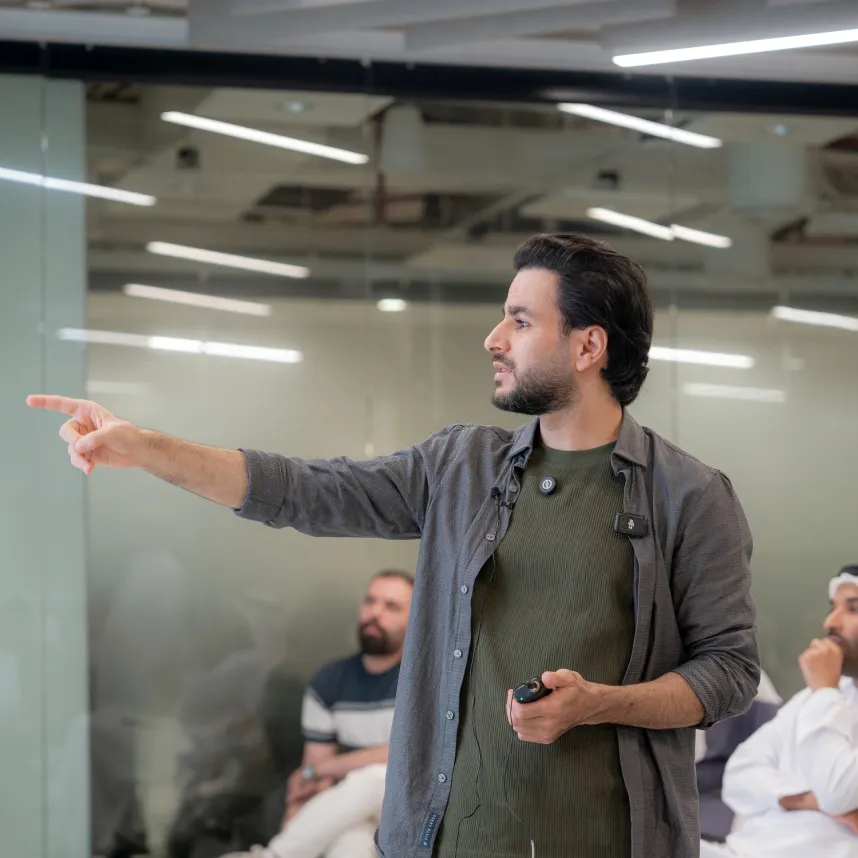
This week, from the Class of 2015, we are featuring Hashem Al-Ghaili, then a molecular biology student, now a global science communicator, who is pushing boundaries at the intersection of science, storytelling, and emerging technology.
QUICK FACTS:
- Graduation Year: 2015
- Major: Molecular Biology
- One stand-out memory: Going to Professor Sebastian Springer when struggling to adapt, and him saying, "The fact that you came here means you're willing to learn. Whenever you have problems, come to me and I will be there to help you."
- Go-to stress reliever: Walking through Knoops Park next to campus
- Proudest moment: Giving the graduation speech after overcoming early struggles to adapt
When Hashem Al-Ghaili returned to Constructor University's campus in June 2026 to deliver the keynote address at this year's graduation ceremony, he brought with him a message forged through his own unconventional journey: that passion, not prestige, should guide your path forward.
A decade after completing his master's degree in molecular biology at what was then Jacobs University, Hashem has built something remarkable—a global platform reaching over 45 million people with science content that has been viewed more than 100 billion times. As a filmmaker and science communicator, he uses cutting-edge AI filmmaking techniques and speculative concepts to make complex science accessible.
We sat down with Hashem to discuss the decision that changed everything, why he chose communication over the lab, and what it takes to build a career at the intersection of science, creativity, and emerging technology.
Decision-making is a central theme of our 25th anniversary. You faced a major decision after completing your master's—whether to pursue a PhD or take a different path. Walk us through that.
This might be counterintuitive, but I think we must be honest: it was the decision to pursue something where I knew my potential was far greater than the alternative.
When I was at Jacobs, I was debating whether to do a PhD after my master's degree. It sounded fantastic, but that would have meant being limited within a lab environment. I wouldn't have had time to publish on social media. Can you imagine meeting your professor the day after publishing content, and he tells you, "I'm sorry, but publishing on Facebook is no excuse for not doing the assignment." That didn't feel right.
So, I decided I wanted to do science communication. As soon as I got the opportunity at Futurism, a media company I worked for at the time, I realized I had greater potential there. There was a lot of need for science communicators, and it was fertile ground—not a lot of people were doing it. I took the chance, and it's one of the decisions I’ll never regret.
Your interest in science clearly predates your time at university. How did studying Molecular Biology shape your trajectory?
Exactly. Since childhood, I'd always wanted to be this scientist working in a lab creating crazy stuff. Then I went in a different direction—which isn't far away from science, I'm still doing science, it's just more on the creative side.
What this university gave me was something specific and transformative. I took an immunology course with Professor Sebastian Springer, and the way he explained things was so simplified. He would take complex concepts and break them down so easily that anybody could understand them. That approach helped shape my science communication career—looking at his way of explaining things taught me how to make science accessible.
You mentioned Professor Springer earlier as someone who supported you during a difficult adjustment period. Can you tell us more about that?
When I first arrived at Constructor, then Jacobs University, I was coming from a university in Pakistan where the educational system was mostly theoretical. At Jacobs, it was all practical—a very different approach. I was facing difficulties at the beginning, so I went to Professor Springer, who was the head of the Molecular Life Sciences program.
I told him I was struggling and asked if he'd made the right choice by accepting me into the program. He said something I'll never forget: "If you didn't come to me with this, I would have said you're not willing to learn. But the fact that you came here means you really are willing to learn. Don't worry about it. Whenever you have problems, just come to me and I will be there to help you."
That gave me a lot of strength to power through and go through all the difficulties, knowing we had amazing, supportive people there.
You've built an extraordinary career as a science communicator and filmmaker, reaching billions of people globally. How do you see the relationship between your passion for cutting-edge science and your love of storytelling?
To me, they're two faces of the same coin. If you look at storytelling throughout human history—starting with drawings in ancient caves, then the invention of paper, ink, printing, photography, filmography, and now virtual reality and AI—it's been evolving constantly. The technologies keep getting better, but the basic element hasn't changed. A story is still a story with a beginning, middle, and end. It's just the medium and style that change, and I'm trying to keep up with that.
Science is for knowledge, and art is for spreading that knowledge. You always need both if you want people to be engaged and interested in what you're telling them. You can't do that without using the proper medium and creative presentation. I've always seen them as complementary, and I love both.
When did you first start combining these interests? Was that something you were already doing during your time at Constructor?
Yes. One of the things I created at the time was called "This Week in Science"—a weekly infographic published every Sunday featuring six to eight science stories from different sectors. They were always going viral.
That's how I got my first job. A group of people in New York saw my work and approached me saying, "We want to give you a freelance position where you can work from Germany doing science communication for our platform." I said yes and jumped right into it.
What advice would you give to students at Constructor who might be facing similar crossroads—passionate about science but also drawn to creative or unconventional paths?
First, do not go for something you're not passionate about, so you avoid burnout. In all my life, I don't think I've ever faced burnout because every day is a new day—I'm learning new things and publishing information about new stuff. Make sure you're really interested in what you're doing.
Second, patience is very important, especially at the beginning. Results might not be swift. For me, I started in 2008 and consistently carried on for seven years until I finally saw results in 2015.
Third, don't make fame and money your goal. They were never my goal—they're the byproducts of passion. If you're passionate and love what you do, everything else will come on its own. Don't chase fame, because if you reach it, you'll ask yourself, "what's left?" and feel empty somehow. Don't make it your end goal.
Fourth, there are a lot of resources and competitors out there. It's helpful to watch what they're doing and try to replicate that—there's no problem with that.
And lastly, embrace artificial intelligence. Embrace it and use it in every possible workflow in your life because it will make things easier, faster, more efficient, and the results will be amazing.
You're now teaching AI filmmaking in Dubai and building workflows that are shaping the AI filmmaking sector. What excites you most about this technology's potential?
What excites me is that AI filmmaking allows people to tell stories without being constrained by budgets. It's cheaper, faster, and produces quality on par with Hollywood productions. That means a generation of people will master the art of storytelling and tell stories in a way we've never seen or heard before.
I continue developing AI filmmaking workflows and pushing them further with every film I create. Each project becomes an opportunity to refine the process, explore new creative possibilities and demonstrate what's possible with this technology. Seeing these films resonate with audiences and be shared around the world motivates me to keep building workflows that are helping shape the future of AI filmmaking.
What does it mean to you to have returned to Constructor University to deliver this year's graduation keynote?
It was incredibly meaningful. When I compare where I started—struggling in those first months to adapt to a completely different educational system—to standing on that stage giving the graduation speech, I felt very proud that I'd overcome all those challenges and made it to that point.
It was also a chance to come full circle and share what I've learned: that the path forward isn't always linear, that passion matters more than prestige, and that sometimes the most important decision is the one to adjust course when you see a better opportunity—even if it wasn't the plan you started with.
If you could look 25 years into the future and see the impact of your work, what would you hope to find?
I’m already starting to see it. I receive hundreds of messages from people saying they were confused about what to choose in life, then they saw a post from me—maybe about a scientist using stem cells to regenerate something—and they send me messages like, "Four years ago I was unsure of what’s next, and now I just got my PhD in stem cell research, all thanks to your post." Or "You made me aware of a treatment I didn't know existed and it saved my mom's life."
You never know how big of an impact you've made because you don't meet these people. It's amazing to read these things.
Looking into the distant future, I'd like to see my work having inspired a generation of learners and thinkers—not those who memorize information, but those who use critical thinking to question things before deciding if something is real or not, especially in an age where it's easy to spread misinformation. A generation of analytical thinkers.
Also, a generation of people who know what they want to do in life, because career choice is one of the biggest confusions people face.
And from the AI sphere, a generation of people who will tell stories that shape society and enhance human creativity in unprecedented ways. These are the things I'm excited about.
Thank you for your time, Hashem!
Receive all updates straight to your inbox.