25 years of Constructors: Joanna Bagniewska - the Communicator
In honor of Constructor University's 25th anniversary, we're featuring alumni from previous graduating classes to showcase the diversity, values and impact that Constructor graduates have carried into the world. Check out our features on 2004 alum Aakash Jain and 2005 alum Neil D’Souza.
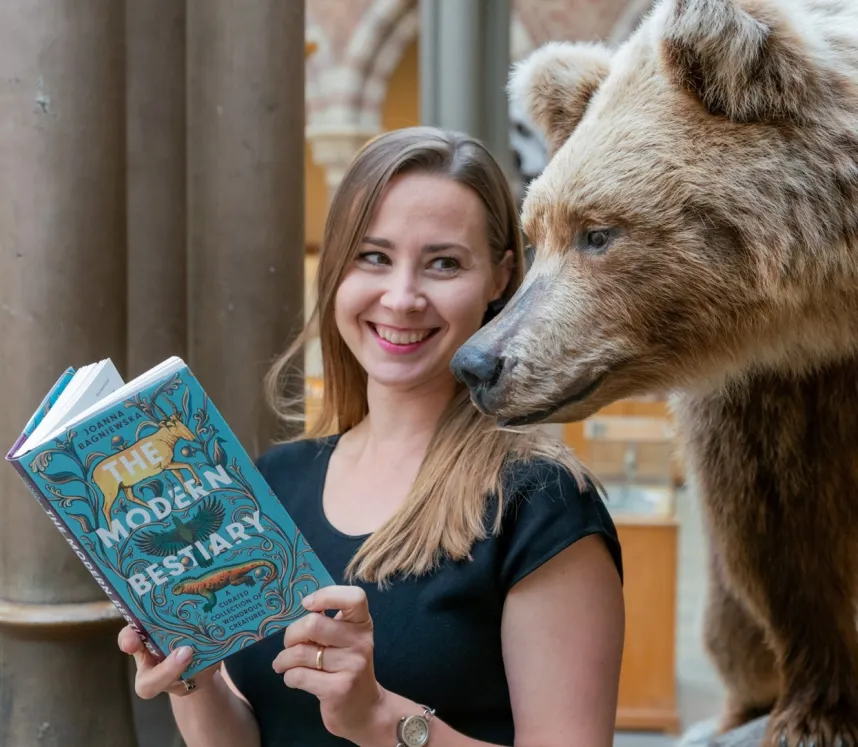
This week’s alumna from the class of 2006 is Joanna Bagniewska, now a successful science communicator and Lecturer of Environmental Science at Oxford University in England.
Quick Facts:
- Graduation Year: 2006
- Major: Biology
- College: College 3 in its founding year.
- One stand-out memory: my first birthday on campus, everyone in my college hid in the hallway outside my room and knocked on my door right at midnight to surprise me with birthday wishes.
- One professor I'd like to buy a beer: there are so many! ... but if I have to choose just one, I’ll say Prof. Dr. Victor Benno Meyer-Rochow, so we can chat about sea cucumber butts and penguin poop.
- My go-to stress reliever: My friend Leon and I would get dressed up and go for ‘fancy’ dinners at the Krupp College servery. We’d bring wine glasses, candles and make a whole event out of it. Sometimes we swapped fancy clothes for clown costumes.
- My Constructor experience in 3 words: building greater understanding.
When Joanna arrived the International University Bremen (IUB) in 2003, it felt more like a novel experiment than an established institution. She joined just two other students in the university's Biology program. In many respects, IUB in those early years could not have been more different than Oxford’s centuries of prestige and convention. Yet, at this plucky, young university still finding its feet, Joanna would discover a strength of her own, one that would help carve a path from Bremen, Germany to Oxford’s hallowed halls: her voice.
We sat down with Joanna to reflect on what her Constructor University experience taught her about speaking up, standing out, and settling our differences over pancakes.
Your passion for animal life and science is palpable and has helped propel your successful career as a science communicator. Can you trace that enthusiasm back to your time as a Biology student at Constructor University (then International University Bremen)?
I think of those early years as a journey of both discovery and elimination that ultimately led me down a path I’m passionate about. One pivotal moment of discovery was undoubtedly my first-year General Biology course with Prof. Dr. Victor Benno Meyer-Rochow, who you may know as the 2005 ‘Ig Nobel Prize’ winner for his amazing paper called “Pressures Produced When Penguins Poo—Calculations on Avian Defecation.” As you can imagine, his course was basically a wild journey through different taxonomic groups that I may never have taken an interest in had he not been super passionate about them.
A key learning from my undergrad experience at IUB was also discovering what I’m not that interested in, which was the largely lab-based biochemistry and cell biology that our program focused on. I found myself moving further away from these topics as my studies progressed and I realized my true interest lied in whole organisms and life in the natural world.
There was also a third-year class—an Introduction to Entomology [Editor’s Note: the study of insects]—taught by Hans-Bert Schikora, a guest lecturer from Universität Bremen. He was brilliant, but unfortunately there wasn’t much of a place in the program at that time for entomology. It turns out not many people shared my enthusiasm for insects... but it was so fascinating to me, that years later when I was teaching my own classes on entomology, I actually dug up his contact details and sent him an email to let him know how much I remembered from his classes and how cool it was to come full circle and use some of the same approaches in my own teaching.
So, I would say both those classes were formative, not just academically but also for my path as a lecturer and science communicator, because they showed me how effective and infectious genuine passion can be when sharing science.
You’re one of few alumni who can say they experienced this university in its very first iteration. How would you characterize the experience of being a student at International University Bremen (IUB) in those very early years?
It was scrappy in the best possible way. We didn't even know for sure whether the university would survive or not, so we had to be proactive about everything. We learned quickly to advocate for ourselves because if we didn't, and if the whole experiment ended up collapsing, where would that leave us? Would we have to go back to square one to get a degree from a "real” institution? That uncertainty forced us to put ourselves out there in ways I don't think we would have at a more established university.
The entrepreneurial spirit was baked into everything. If you wanted to do something, you just had to do it. Nobody was stopping you. There weren't forms to fill out or endless bureaucratic approvals. You want to start a club? Great, start a club! You want to organize a performance? Go for it! It was so easy compared to established institutions where, by the time you navigate all the red tape, you're too exhausted to actually do the thing you wanted to do in the first place.
Can you give an example of that entrepreneurial approach in action?
Absolutely! I was in the biology program with just two other students. As I mentioned earlier, the curriculum was very lab-focused with lots of biochemistry and molecular work. I found myself struggling to relate to the material because I wanted to work with whole organisms and animals in their natural environments. In the spirit of IUB, I thought, "Well, I'm going to do something about it!"
I did some research and found a course in animal behaviour offered on the other side of Germany in Nuremberg. I had the audacity to go to my professors and say, "Look, I see a gap in the curriculum. The university won't be able to teach animal behaviour, but luckily I’ve found a place that does. Can I please have ten days off to go to Nuremberg to study this... and can the university please pay for it?"
To my surprise, they actually agreed to my proposal! I really didn't expect them to say yes back then, and I find it even more unbelievable now in hindsight. But that's the spirit behind “if you don't ask, you don't get.” That course opened the door to further studies at the University of New South Wales in Australia and Rice University in Texas, because I'd enjoyed ecology so much. Those experiences cemented me as a zoologist, and it all came from being dissatisfied and doing something about it, crucially, with the support of professors who said, "Yes, go for it. If this is your passion, go do your thing." I really appreciate how supportive they were, despite my interests not aligning with their own. I’m not sure I would have had that experience at any other university, and it ended up being incredibly formative for my life.
How do you think being part of this “scrappy,” unproven university shaped the way you approached later opportunities?
Towards the end of my undergrad, when I had already been accepted at Oxford, I was invited to a conference to present a paper. People were generally nice to me, but there’s a limit to how seriously you can expect to be taken in these settings as an undergrad. Yet, I noticed how the moment I mentioned I'd been accepted to Oxford, this would suddenly flip, as though people were thinking, "oh, okay, so she is someone worth paying attention to."
The experience taught me that it was actually a much healthier starting point for me and my cohort to be underdogs who had to fight and be persistent to get noticed. We didn't have the luxury of resting on any laurels. If I'd started at Oxford, I probably would have coasted and thought, "Well, I'm here, so clearly I'm the best." But at IUB, you had to prove yourself through your actions, not just through the name on your degree.
Now you are at Oxford, one of the oldest and most reputable universities in the world! How do you compare that environment to the one you experienced at IUB?
On the one hand, Oxford has a huge population of international staff and students. If you look at the proportions alone, you could even argue that it’s as international as Constructor University is today... and yet Oxford is not an ‘international university’. It is a British university that happens to have a lot of international members, but that is not the same thing.
What do you mean by that? What made IUB truly “international?”
At IUB, you weren't expected to conform to any particular set of national or cultural norms. People were encouraged to celebrate their culture, talk about it and introduce it to others. I don't think there are many places where you truly get to meet and interact with international people on their own terms, and see those differences truly embraced. That carried through into how we studied, worked and researched together. How people approach things like decision-making, communication, hierarchies (or lack thereof) and risk are massively shaped by their upbringing and cultural experience. We gained a lot by being in an environment where these differences weren’t treated as ‘right’ or ‘wrong’, they were just differences that could be openly discussed and worked though.
What did that look like in practice? Can you share an example of that kind of internationality in action?
Yes! During orientation week, we were sorted into small groups. Our group’s advisor, Szymon, decided a good group exercise would be to make pancakes together, and started by posing the question: how do you make pancakes? In our group of seven people from all over the world, we came back with seven different recipes and seven different ways to make pancakes.
Do you add sugar to the batter? Do you fry them with oil or add oil to the batter? What flour do you use? Do you use eggs? Are they fluffy or flat? The whole definition of what a pancake even is was up for debate. Do you eat them with whipped cream and strawberries or something savory?
It was such a routine task, but it was eye-opening. That confrontation of different realities, backgrounds, ideas and perspectives happened throughout my degree at IUB. It helped me understand the importance of learning where other people are coming from. This has helped me immensely with science communication as well.
Time to add Pancakes 101 to the curriculum! Do you think the need for cross-cultural understanding has changed at all in the 20 years since you graduated from IUB?
I think it's more important than ever! The most fundamental problems we have right now stem from isolation, loneliness and lack of shared experiences. We live in bubbles. Our social media algorithms curate timelines of things we want to see, and as a result we largely interact with people who agree with us, but that's not reality. When I was an undergrad, Facebook was still brand new, so it was a very different world. If you don't go out of your way to meet and interact with people who are different than you, it may not happen by chance anymore, and you can find yourself in a mental rut.
At IUB, you were faced with new cultural experiences and interactions by design, from day one. You could have a roommate who'd been raised completely differently, with different priorities, beliefs, values, levels of cleanliness, different everything.
Yes, it could be uncomfortable at times, but I think that kind of discomfort is good for people. Learning is not about being comfortable, it's about trying new things and taking on challenges. I had a Polish friend whose roommate was from Trinidad and Tobago with a very strong Caribbean accent, and for the first month they had to write notes to each other because they couldn't understand each other's English. But they figured it out together because that's what you do, and it became a really positive experience for them.
Looking back now on your time at IUB, is there anything you would have done differently?
Honestly, I think I made the right decisions. The fact that I clawed my way into being a zoologist came from dissatisfaction with being forced into biochemistry. But I did it with the support of professors who said, "Yes, go to Australia, go to Texas, do your thing." I didn't have the academic background for it initially, but they gave me the confidence to pursue it anyway. That "just ask" mentality has stayed with me and served me very well over the years.
What advice would you give to current Constructor students?
First, don't be afraid to ask for what you want. The worst they can say is no, which is what you’re saying to yourself by never asking. But if they say yes? That's when the magic happens.
Second and perhaps most importantly, learn to build and value relationships. At the most basic level, any job, any life is about relationships—how we approach them, how we build them and how we maintain them. Take advantage of being in this unique environment where you're surrounded by people from completely different backgrounds. Don't just tolerate the differences of those around you. Embrace them, get to know them, learn from them and let them challenge you.
Thank you for your time, Joanna!
Receive all updates straight to your inbox.