Forget the serious travel apps and embrace getting lost in the "Golden City" of the North. Come for the grandiose palace views that looks straight out of Bridgerton, but stay for the legendary statue of citizens baring their bums at a Duke and the introverted chill vibe of the city.
Schwerin is a small city in the North East of Germany. If you’re looking for a picturesque city in the North for a day trip, Schwerin is easily your best option. I would describe it as the city for the “introverted traveller”. Why, you may ask? Because it is one of Germany’s least populated state capitals with a population hovering below 100,000 people. What does this mean for you? No congestion and no noise; you can discover the city and all its tourist attractions free of any disturbance. You get to look cool, sophisticated, and “touristy” in a small city for your own amusement and for the pictures that you’ll keep as memories.
A trip is nothing without pictures and videos for commemoration, so for the people who love photography or filming content, you won’t have to worry about random passers-by walking through your shots and ruining a curated “aesthetic” moment, as they say in internet lingo. You can avoid the awkwardness and embarrassment that many of us have felt while filming in public. Even though it is a Bremen day trip, it is still the perfect getaway. From the bustle of Bremen, I present Schwerin for your attraction — and get this — FOR FREE! Thanks to the semester ticket.
The Journey: A Scenic Route from Bremen.
Remember, it is meant to be a “chill trip”, so put aside the normal Deutsche Bahn app and FahrPlanner, which make everything feel “so formal and serious”. Relax and embrace getting lost, just like I did. Use good old Google Maps; with the reputation that precedes it, on this day trust that it will work wonders positively. And if you’re feeling a little exploratory and risky, don’t rely on the internet, just wake up with your route in mind and go the old-fashioned way. Be present!
- Bremen to Hamburg. Head to the Bremen Central Station, and take the Regional Train to Hamburg Central Station. This journey is just over an hour. Don’t stress; if you are late to the station, no pressure, as the train to Hamburg comes every hour.
- Hamburg Transition. Now, Hamburg Station has the reputation of being a bit overwhelming and hard to manoeuvre — which is fair, because it is the busiest train station in Germany. But take it from me: it is not that difficult. It is actually simpler to manoeuvre than you may think.
- The Scenic Train Ride. From Hamburg Central Station take the Regional Train to Lubeck Main Station (45 minutes) and this Regional train just like the train from Bremen to Hamburg also runs every hour. From Lübeck catch another train to Bad Kleinen (50 minutes) and — you guessed it — runs every hour too. Once you are in Bad Kleinen take the final train to Schwerin HbF which is a quick 10-minute hop.
While it seems like a lot of connections, trust me, it is well worth it. The journey to Schwerin takes at most 4 hours if you factor in the waiting time between train rides and any break that you may need in between to grab some food. So plan your departure from Bremen early and accordingly! It’s one of the best day trips from Bremen Germany — make sure to sit in the upper deck of the train for the views!
Exploring a “Disgustingly Walkable” and Clean City.
Upon arrival at the Schwerin station, you need not get into any other vessel of transportation. I’d assume that any person would want a break and welcome the fresh air after being trapped in 4 trains. Additionally, Schwerin is a small city that is disgustingly walkable; given the city’s urban planning and architecture similar to most German cities, the main places to visit and attractions are clustered around the same area or within a short stroll of one another.
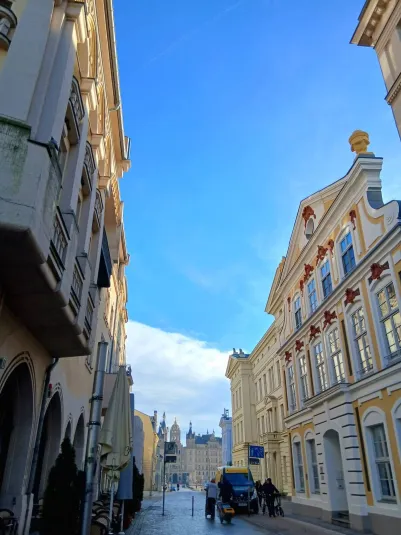
Pro tip: One thing to keep in mind is that you are better off visiting Schwerin on a sunny day; your eyes and the city will thank you for doing so. Thanks to the association between warm tones, joy and positivity, the city’s colour palette is so warm-toned that it practically radiates happiness and a feeling of calm — perfect for a memorable high-energy trip. I recommend walking through the city; I guarantee you’ll go ‘wow’ a couple of times since everything looks so put together and complementary. If you are observant, you might even sense some whimsy in the architecture of the town and notice some astonishingly bright colours on a building or two. The narrow streets in some areas of Schwerin might even have you feeling like you are in a miniature Paris.
The Crown Jewel: Schwerin Schloss.
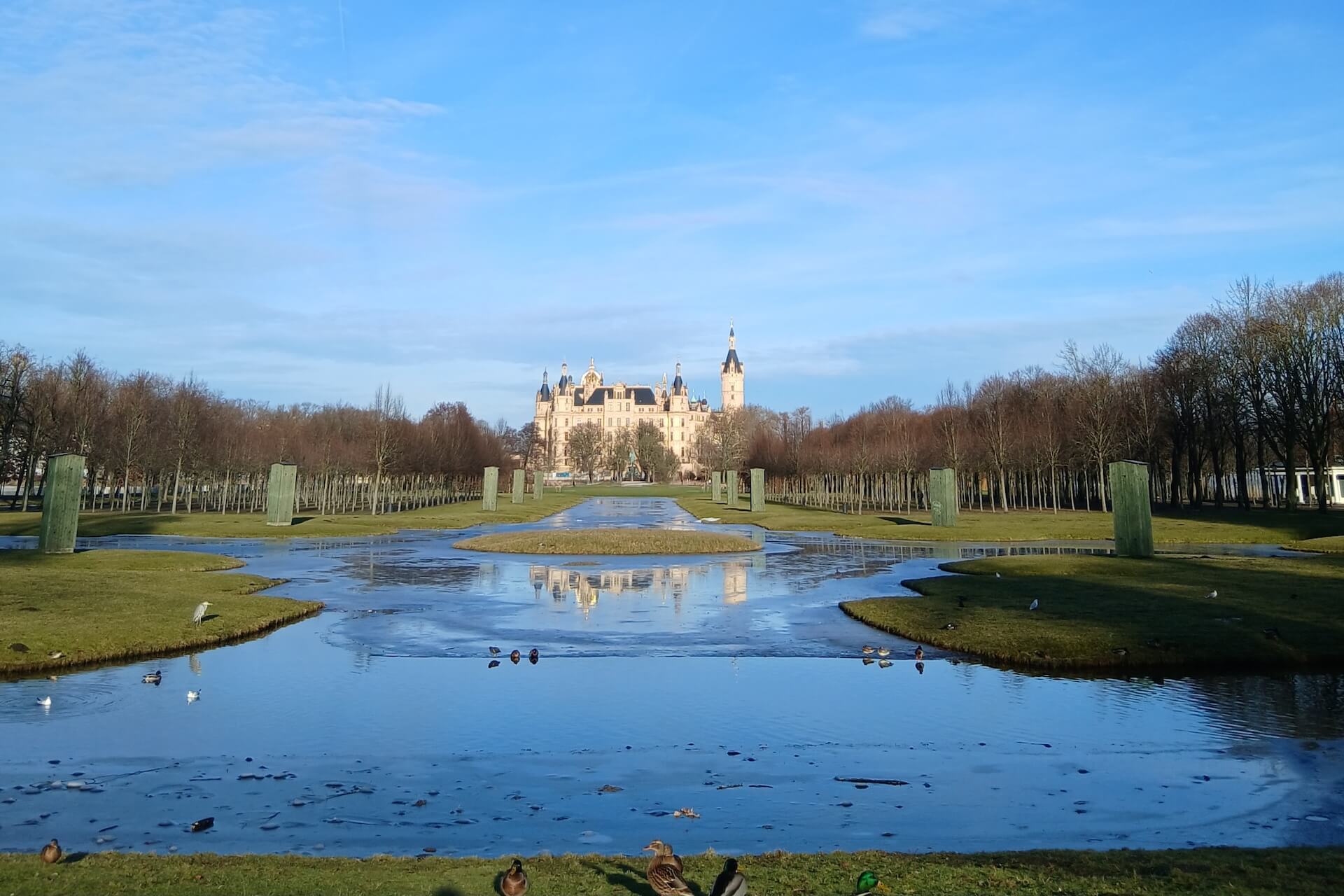
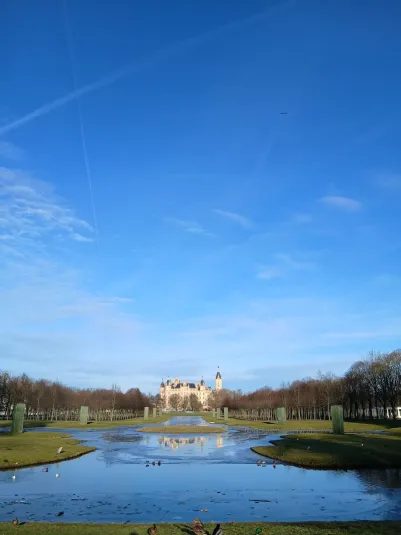
Our first stop was the Schwerin Castle, also known as the Golden Castle. The castle actually unfolds as you walk through the city towards it; you may even have to pause in the middle of Scholssstrasse just to marvel at the view in front of you. Like a cinematic reveal, the views just get better the closer you get. It sits on its own island in Lake Schwerin. If you’re a fan of period or historic European dramas, you’ll be stunned; its vibe and outlook, look remarkably similar to a set from Bridgerton. The castle is a museum and also serves as a parliament to the local city’s government.
- Entry fee: €13 for adults
- Reduced rate: € 9.00 for students. (Don’t forget to carry your student ID!)
- Free for people under the age of 18.
If you want to keep the trip entirely free, you can wander through the castle’s garden FOR FREE. You may let your mind roam free and imagine how it must have felt for the royals that lived in Schwerin Castle centuries ago in their royal clothes and posh accents — think of how it felt waking up to the breathtaking view by virtue of being royals and walking through the expansive garden.
While most people recommend going to Schwerin in the summer or spring, visiting in the winter has its perks too; the key is a sunny winter day, as the Golden Castle has its accurately golden moment in the sunshine. You’ll enjoy fewer tourists and the sight of Lake Schwerin in all its frozen glory, with the seagulls and other birds literally “walking on water”.
Look out for these highlights as you explore the castle gardens:
- The Picture Frame Wall: In the most literal sense of the word, this is a white wall next to the lake that is built like a picture frame. I’m not sure what its specific purpose is, but be sure to take many pictures!
- Stone Cave: There’s a path leading towards this stone, cave-like entrance that’s covered with climbing plants. It borders the lake, with parts of the frozen lake passing through it. The monument is a bit creepy and dark from the outside, but very picturesque inside, especially when the sun is shining right through it.
- Schlossbrunnen: You could also decide to go up the stairs to what would look like just a terrace to the untrained eye, but is actually the Schlossbrunnen near the Orangery — a beautiful garden with a fountain in the middle. To see the magic of this in its entirety when everything has bloomed, visit in the warmer seasons.
- Schwabende Victoren (Floating Victories). In this “terrace” area, you’ll find the white Schwabende Victoren, two white-winged female figures standing atop the Orangery of Schwerin Palace.
- Herkales-Skulptur: Around the same path, you’ll be able to see the Herkales Skulptur, which is a sculpture of Hercules taming a bull. If you’ve heard of the phrase “taking the bull by the horns”, this statue visualises it precisely
Schwerin Castle and its surroundings are home to many statues and sculptures—even a David and Goliath one—so be sure to check them all out.
South of the Castle: Schloss Schwerin Burggarten.
Leaving the immediate castle surroundings, you could walk to the back south of the castle to see Reiterstandbild Friedrich Franz II. It is a grandiose, green statue of a man on a horse with four other people seated around him; there is history written on a plaque for your reading right beside it. You’ll also see a very romantic garden tunnel right beside the statues. While walking inside, you’ll understand why I describe it as a “possible proposal hotspot”; I know for a fact that the tunnel has witnessed hundreds of proposals in its lifetime! The green statue sits between the castle and a body of water resembling an unsheathed sword from an aerial view. When you’re done walking around the garden of the castle and admiring its beauty, you can leave through the magnificent floating meadows and abstractly illusionary gates of heaven, called the Avenue of the Gates of Heaven. These rectangular white frames create a stunning and strong perspective that plays with light and your eyes, which is the best way to end your exploration of the Schwerin Castle Island.
Into the city: Passive musuems, Lions, Legends and a whole lot of history.
The next things to do in Schwerin can be found inside the city and near the market square. To go there you’ll exit the Schwerin Schloss and its island to passively see the Staatliches Museum and Mecklenburgisches Staatsheatre on your right.
There are a few monuments that are very impossible to miss, like the Yellow Rokokohaus, which sits right in the street leading up to the castle, Schlosstrasse. The bright and attractive building built in 1765 is funnily enough a police station currently. Nothing screams “here to serve the people” like a sunshiny police station looking all bright in red and yellow!
On your way to Market Square, you’ll see a huge, rather peculiar-looking metal thing; anyone’s first instinct would be to pay it no mind, and I don’t blame anyone for this. It is described as the kind of art that you “wouldn’t be so keen on”, but it’s very important that you “are so keen on” it. Take a minute or more to look at it, just like any other art piece, especially monuments like this. Take the piece in and appreciate it in all its rusty, “metally”, peculiar and boring splendour. You are on holiday after all, aren’t you? Known as the Skulptur Runder Tisch or The Round Table. It was created during a period of transition, reunification, and new beginnings and holds such sentiment to the people of Schwerin and the artist, as it represents the freedom of the East.
Upon reaching the Löwenmarkt—the market square which translates to Lion’s Market—you’ll see the almost light-pink, creamy brown Rathaus, which, unlike other extravagant town halls in the country, glows in its simplicity. Right next to it sits the Auktionhaus. This market square is a beautiful palette: the white, pink, and earthy tones of the Rathaus, the yellow of the Auktionhaus, and the deep red of the towering cathedral behind it come together in harmony. The colourful backdrop perfectly complements the snow-white Neues Gebäude (new building) that’s right in the middle of the square. Acting as the perfect viewpoint for the star of the show: The Lion Monument (better known as Löwendenkmal), situated right in front of the building.
This apparent monument stands erect on a fifteen-foot pedestal, but it holds more meaning than one would expect—especially if you pay close attention to the detail on the walls of the base. While the Lion is a commemoration of Henry the Lion, the person who founded the city, the statue also represents a comical and satirical rebellion against the same Duke Henry. Through the subtle, insubtle mockery, the citizens are depicted bearing their bums at him! Right behind it, you’ll find the Schwerin Cathedral; upon walking around it, you’ll see another slightly forgettable Lion Monument. You’ll notice that in Schwerin, there are two: the one inside the Market Square and the Braunschweiger Lowe. This one being a bit more generic, slightly less interesting, and not as lit up as the first one, but still worth the look.
Last stops.
The town’s market square, though tiny, has lots of stories to tell. However, you haven’t really seen Schwerin until you get to the Pfaffenteich Pond, where you’ll find the sculpture Schirmkinder (Umbrella Children). To the left of it stands a huge, wide, impressive brick orange building: the Arsenal am Pfaffenteich. On this sunny day, its magnificence was accentuated by the setting sun, with the rays hitting it in all the right places. The building is located close to the city center near the pond, which was frozen at the time. Still, the people of Schwerin found a way to make the cold enjoyable; you could see people seated on the steps romantically looking towards the icy pond before them, while others fed pigeons right beside the sculpture of the child holding an umbrella.
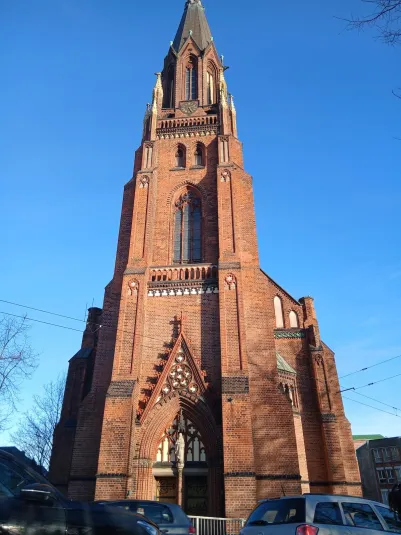
Finally, an honourable mention goes to the St Paul’s Church. This was not in the travel itinerary at all, but we happened to bump into it while walking back to the Schwerin Train Station to catch our train to Bremen. Unlike the cathedral, it is quite hidden and in a very quiet old part of the town, which seemed residential, as there were no other tourists in sight. The church was apparently inspired by the French Gothic Lutheran Architecture, and it definitely lives up to the inspiration, looking eerily Gothic despite its bright reddish-maroon exterior.
These are some of the few things to do in Schwerin for a day trip. Schwerin is a must-visit for anyone living or looking to visit Northern Germany. There’s still more that couldn’t be explored on this day because of time and the obvious winter weather, but perhaps you can plan a weekend trip or a day’s escape, whether with friends or even alone. Regardless, you’ll definitely enjoy it — you’ll likely spend your train ride back to Bremen like my friend and I: looking at all the photos and videos we took and smiling and exclaiming foolishly at how “touristy” we looked with our sunglasses in the sunny winter, but satisfied that we took the time to go on this well-needed trip.


