High-speed learning: Constructor University’s AI car takes on the world’s best in autonomous racing final
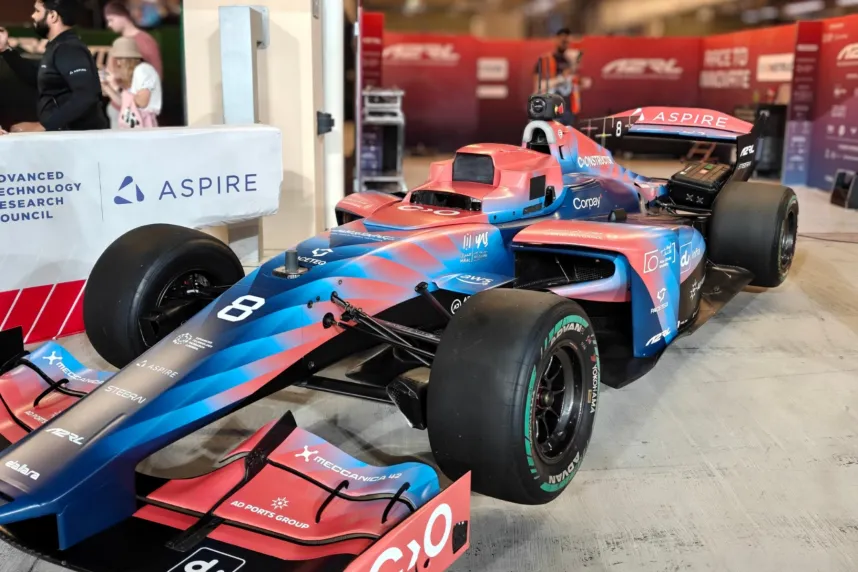
For the second time in as many years, Constructor University’s autonomous racing team reached the grand final race of the Abu Dhabi Autonomous Racing League (A2RL). The League’s second season saw fierce head-to-head – or more accurately “AI-to-AI" – competition between 11 teams representing some of the world’s top universities and research institutions. Piloted only by the custom AI software developed by a joint team from Constructor University and Constructor Technology, the team’s car powered through qualifying rounds to earn a spot in an action-packed main event between the top six cars at the Yas Marina Circuit in Abu Dhabi.
"It is amazing how A2RL has progressed within just one year, especially with respect to the lap speeds and the fact that in the final gold race, six fully autonomous teams were racing again each other,” said Andreas Birk, Professor of Robotics at Constructor University. “It is a great achievement that Constructor made it up to the final gold race, even though our team is very small."
The pace of the sport's progress was on full display in its second season, with the high-performance autonomous vehicles shattering previous speed and lap records. Qualifying action saw top speeds of 295 km/h recorded, and in a truly jaw-dropping moment, one car even beat the course benchmark lap time set by a professional human race car driver. The Constructor team knew it would face steep competition in the final but likely did not anticipate being front and center in perhaps the most dramatic moment of the season. Near the halfway point of the race, their car collided mid-turn with a car from Italian team Unimore, sending both vehicles off the track and ultimately giving the win to returning champions Technical University of Munich (TUM).
"The final race showed how much is demanded from each of the AIs that are piloting the race cars, from lowest level control aspects like handling the temperature-dependent traction of the wheels up to high-level decision-making, such as reacting to unexpected events or deciding if, when, and how to overtake,” explained Prof. Birk.
Check out this A2RL recap video from the Constructor team to see behind-the-scenes action for yourself.
Racing to a safer future
If there’s a silver lining to be gleaned from Saturday’s result, beyond recreating the excitement that helped popularize human racing like Formula One, it is how all outcomes from these autonomous racing events contribute to the safety, accuracy and reliability of autonomous systems used in vehicles more broadly downstream.
“The A2RL is not only about racing; it’s about pushing the limits of AI performance, adaptability and safety. These competitions give us invaluable, real-world data for advancing autonomous systems,” Dr. Birk added. “At racing speeds, our sensors and algorithms are pushed to their absolute limits. This environment helps us make autonomous technologies more precise, reliable and safer; advancements that will directly benefit future mobility and robotics applications.”
All teams in the A2RL are equipped with the same Dallara SF23 race car, considered one of the fastest in the world outside of Formula One . With each car sporting identical sensors and hardware, the League’s 11 teams relied entirely on their own custom-built software to gain the winning edge through navigation, control and strategy. Constructor University’s success in reaching the final race in both seasons so far underscores its commitment to research and innovation in AI, robotics, and data science.
Receive all updates straight to your inbox.