Bremen’s best: Constructor University’s Chukwuemeka Achugo and Dr. Tridib Banerjee receive 2025 Bremen Thesis Award
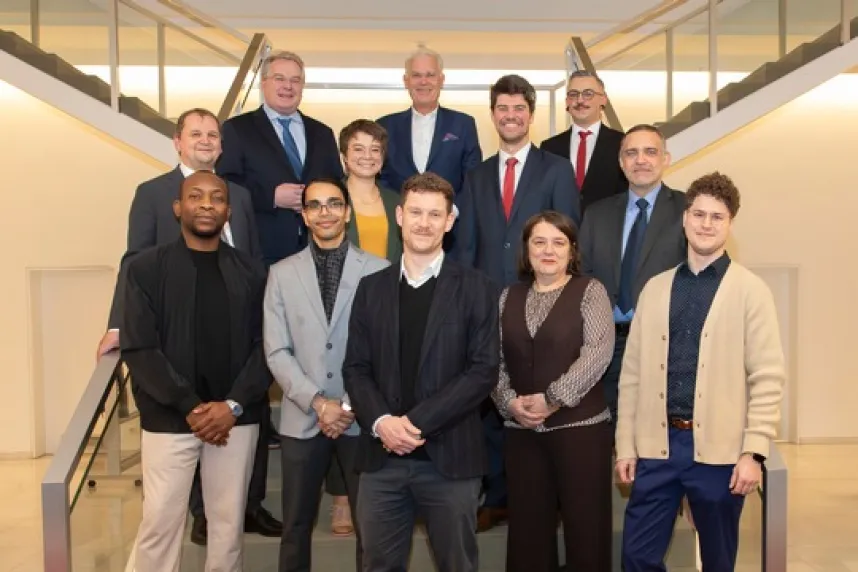
Two Constructor University researchers were awarded the 2025 Bremen Thesis Award (Bremer Studienpreis) in recognition of their exceptional academic contributions at the Master’s and PhD levels. Mathematics doctoral researcher Dr. Tridib Banerjee and computer science Master’s graduate Chukwuemeka Achugo were presented with their awards on November 18 at the Bremische Bürgerschaft, alongside other winning students from the University of Bremen. The annual honor is awarded by unifreunde – a joint endeavor between the University of Bremen and Constructor University to recognize the most innovative research emerging from the region’s universities. This year’s recipients were selected for their intellectual rigor, scientific relevance and willingness to tackle complex questions across disciplines.
Dr. Tridib Banerjee received the award for his dissertation, “Numerical mixing across density surfaces in ocean modelling.” His project advances the understanding of physical mixing processes in the world’s oceans, a topic with implications for climate modelling, environmental forecasting and large-scale Earth-system simulations.
Chukwuemeka (Emeka) Achugo was recognized for his thesis, “Generating Test Oracles with Generative AI,” which investigates how emerging AI systems can improve the verification and reliability of software. His work offers a fresh perspective on the intersection of machine learning, software engineering and automated quality assurance.
This year’s ceremony brought together leaders from academia, government and industry to emphasize the essential role of scientific diversity and intellectual courage in shaping solutions for an era of global change. With a prize of €1,000 for doctoral dissertations and €500 for Master’s theses, the prestigious honor places a spotlight on research from the region that cuts across conventional boundaries and inspires new approaches.
For the two Constructor University honorees, the milestone provided meaningful recognition for both the strength of their work and the people who supported them along the way.
It takes a village: Dr. Banerjee
Dr. Banerjee described the award as a welcome surprise that helped him find new confidence and appreciation for his chosen research path, and new gratitude for the community of support behind his success – from mentors and colleagues in academia to his wife and family. Dr. Banerjee thanked his PhD supervisor and Constructor University Math Professor Sören Petrat for suggesting and initiating his nomination. “I shall be forever grateful to Sören for believing in me, even when I didn’t believe in myself,” said Dr. Banerjee. “From the nomination to eventually winning, it was all very unexpected and surprising,” he said. “Winning the award helped me overcome personal worries that my work is not useful. It also made my parents very proud, which brings me great joy.”
Originally from West Bengal, India, Dr. Banerjee can trace his fascination for mathematical models of fluids back to his earliest days in university, a passion that has since taken him on a global journey. In Singapore he completed master's studies focused on aerospace fluid modelling in propulsion and aerodynamics before being drawn to Germany by the chance to work on a global ocean model at Constructor University. “Finding a topic that I knew I could love deeply was my highest priority. When I came across my PhD topic at Constructor, I seized the opportunity with both hands. Looking back now, I am so glad I did,” said Banerjee.
In his laudation speech, professor Petrat commended Dr. Banerjee for the real-world value of his research as well as his command of the topic. "Climate scientists use data and large numerical models to understand the future climate and estimate possible societal risks. Making these models more accurate and reliable is a difficult task that requires a strong grasp of mathematics, climate science and computer science. It is rare for PhD students to be in a position to make valuable contributions in this area. Therefore, it is a special pleasure that the Constructor University prize goes to Tridib Banerjee,” he said.
Hard work pays off: Emeka Achugo
As Emeka Achugo accepted the award for his Master’s thesis, he reflected on the twist-filled journey that led to that moment. When immigration and visa issues prevented Achugo from traveling to Germany for his studies, the Nigerian software engineer nevertheless persisted, opting to complete the first year of the program remotely before relocating to neighboring Switzerland to complete the degree from Constructor Technology’s sister facility in Schaffhausen. Once there, Achugo navigated an intensive backlog of deferred in-person exams, in addition to the language barrier, social isolation and financial pressures. However, these same adversities led to new open doors: In Schaffhausen, Achugo connected with Constructor Technology Professor Mauro Pezze, who became an invaluable mentor, supervising his thesis and welcoming him into a research community working on AI in quality engineering and software testing.
“When I approached Professor Pezze about my interest in software testing, he told me about this work he was doing with PhD students, using AI to generate test oracles in Java projects. This really started to guide my interest in the topic,” Achugo said. “In my eight years working as a software engineer, I very much came from the ‘old school’ that learned coding manually by grinding it out, before models like ChatGPT began to change everything. So, this seemed like a perfect marriage between my interest in testing and the opportunity to better understand and work with generative AI.”
The culmination of these events into the Bremen Thesis Prize left Achugo with an immense gratitude for the support and mentorship he received from Professor Pezze and others, as well as a deep sense of pride in having persevered through uncertainty and hardship to achieve the academic milestone in Germany. “I knew it would be challenging, but to actually come out the other side and see the hard work not only pay off but be recognized in this way, it feels really special,” he said.
The experience also helped open doors in the job market, leading to Achugo’s current career in AI-driven software engineering in Berlin. “With the entire industry moving towards AI, companies would see the topic of my research and immediately be interested in my knowledge and expertise,” he said. While he is currently content to focus on stabilizing his life and career in Germany, winning the award may have also re-sparked Achugo's long-term interest in academia. “It gives me this conviction that the sky really is the limit. If you want it, you can achieve it,” he said.
Receive all updates straight to your inbox.