Pitching the future at Constructor Start Demo Day, part 1: meet the first four startups competing for $100k
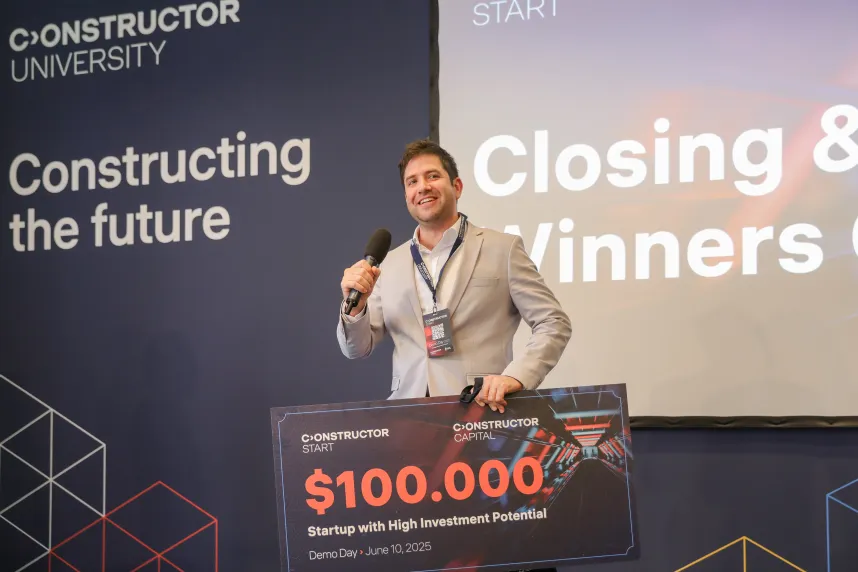
One pitch. One shot at $100,000. These are the stakes for the latest finalists of the Constructor Start accelerator program when they take the stage at Constructor University’s Demo Day on February 24. Together, these 14 early-stage tech startups represent some of the most promising and disruptive AI-related business ideas from across the globe. In this three-part series, we are taking a closer look at each finalist and the businesses they are building.
After honing their business plans through an eight-week intensive curriculum with mentorship from Constructor University’s global network of business leaders, Demo Day will see each team pitch their vision to investors, venture capital firms, media and the public for a shot at securing life-changing investment. The top team will receive $100,000 in equity-free seed funding from Constructor Capital, part of a funding pool of up to $1 million available to Constructor Start participants.
This first installment in our three-part series shines a spotlight on four startups that are applying artificial intelligence to some of life’s most human challenges, from helping us navigate daily routines, to learning more effectively and even bringing new life into the world.
Demo Day Finalist Features: read part 2 of this series next.
Atlantis AI (United Kingdom): the future of personal assistants
What if an AI assistant could follow along and actively support you throughout your day, instead of waiting passively behind a prompt box? This is the question that inspired Atlantis, the personal assistant that “lives” locally on your devices and uses all available data points – from your calendar and email to biometrics and health signals – to help you make better, more informed decisions throughout your day.
Instead of adding yet another tool that requires time, attention and input to use, Atlantis does its learning in the background – getting to know your schedule, patterns, priorities and goals – so it can be present and ready with timely prompts and informed advice when you need it most.
“Today's AI assistants are powerful but fundamentally disconnected from your actual life. Using them means letting big tech complete their already comprehensive profile of who you are,” states the London, UK-based start-up on its website.
By contrast, Atlantis prioritizes user privacy as much as it does personalization. By operating 100% natively on a customer’s devices (with the option to sync across devices using an encrypted bridge), Atlantis is designed for zero personal data exposure and fully complies with privacy regulations like the European Union’s GDPR and AI Act. The result is a private companion that understands your needs and helps you get the most out of each day.
XFactor Academy (Mexico): redefining workplace learning for the AI era
If you’ve ever endured a self-guided Excel tutorial or video seminar on holding effective meetings, you likely know all-too-well the challenges of modern corporate learning: stale, static content, low learner engagement, dismal completion rates and almost no long-term knowledge retention, all at a premium price. That’s why XFactor Academy is taking aim at the $100 billion LMS (Learning Management System) market with its AI-native learning platform.
With AI directly built-in and guiding its core learning workflows from day one, XFactor Academy users experience engaging learning content that continuously adapts to their individual needs, pace and learning style. Instead of navigating bloated, one-size-fits-all enterprise LMS libraries, XFactor Academy learners are guided through adaptive, individualized journeys that combine generative AI, conversational interfaces, and gamified pathways with built-in rewards to keep them engaged and progressing toward their learning goals.
The founders behind this Mexico-based startup have their sights set on organizations that find traditional LMS platforms too complex and expensive, and content marketplaces too generic, namely high-growth SMEs, mid-market companies, and training providers with distributed teams. In their five-year vision, XFactor Academy could become an integral part of a business’s daily workflow, with employees receiving short, personalized learning moments throughout the course of their work, instead of stand-alone training sessions.
From onboarding new staff to rolling out new skills and gaining deeper insight into employee learning outcomes, XFactor Academy is ready to redefine learning in the post-AI workplace.
MetaNeural (USA): Risk-free training for high-risk workplaces
MetaNeural is another startup using AI to transform the way we learn, but this time with a focus on workers doing some of the most dangerous jobs. This American startup based in Texas has developed an AI-powered platform that creates immersive and realistic XR (virtual and augmented reality) training simulations for workers in high-risk industries like semiconductors, energy, aerospace, manufacturing and critical infrastructure.
Unlike conventional VR/AR engines that require intensive manual scripting that can quickly fail to keep pace with changing needs, MetaNeural’s proprietary HazardousXR™ engine gives operational experts the power to generate complex, company-specific simulations using their own operational data and CAD files. By simply describing the scenarios they wish to train for using natural language, instructors can recreate the exact environmental conditions their workers must navigate in the real world.
In high-risk workplaces where timely action and sound decision-making can prevent damage, injury or even death, traditional training formats such as presentations and videos often fail to properly equip workers with the necessary on-the-ground knowledge, skills and reaction time. More immersive training methods using actual equipment or conventional simulation technology can be costly, rigid and lack scalability.
In the same way that flight simulators transformed training in the aviation industry, the founders of MetaNeural see an opportunity to address a massive need for effective and realistic training tools that are capable of keeping up with modern complexity. With HazardousXR, they plan to push the limits between simulation and reality, empowering high-risk industries to train safer, faster and at scale.
CellKinetica (Switzerland): helping to deliver the gift of life
Few decisions are as deeply personal or emotional as starting a family, especially for 1 in 6 couples who will struggle with infertility along that journey. While in vitro fertilization (IVF) is a promising option for many couples navigating infertility, choosing a healthy embryo that leads to a successful pregnancy can still often take several attempts, each punctuated by stress, disappointment and even grief.
Switzerland-based biotech startup CellKinetica has developed a data-driven software solution to help IVF patients achieve pregnancy sooner and alleviate the burden of infertility. The software uses a biomarker based on genomic data to help IVF clinics select embryos with the highest chance of pregnancy, leading to faster, healthier and happier outcomes for prospective parents.
Where embryo selection can often be non-standardized and highly subjective, CellKinetica leverages empirical data to deliver results: in a retroactive review of more than 500 IVF pregnancies where multiple embryo transfers were needed, the start-up found that as many as 40% of the patients would have conceived faster had CellKinetica guided embryo selection.
Because the software analyzes genome data that has already been gathered using PGT-A testing (Preimplementation Genetic Test for Aneuploidy, a widely used test in many IVF clinics), it requires no further invasive procedures for patients, while also adding additional value to PGT-A tests. With a scalable, evidence-backed solution that integrates seamlessly into existing clinic workflows, CellKinetica is poised to launch in the $32 billion IVF industry.
More finalists to come...
These first four startups offer a glimpse into the ambition and range of this year’s Constructor Start finalists. In our next installments, we’ll look at finalists with big ideas and bold technologies for business and deep tech, as we build towards a Demo Day where one pitch could change everything.
Receive all updates straight to your inbox.