Pitching the future at Constructor Start Demo Day, part 2: meet five more startups competing for $100k
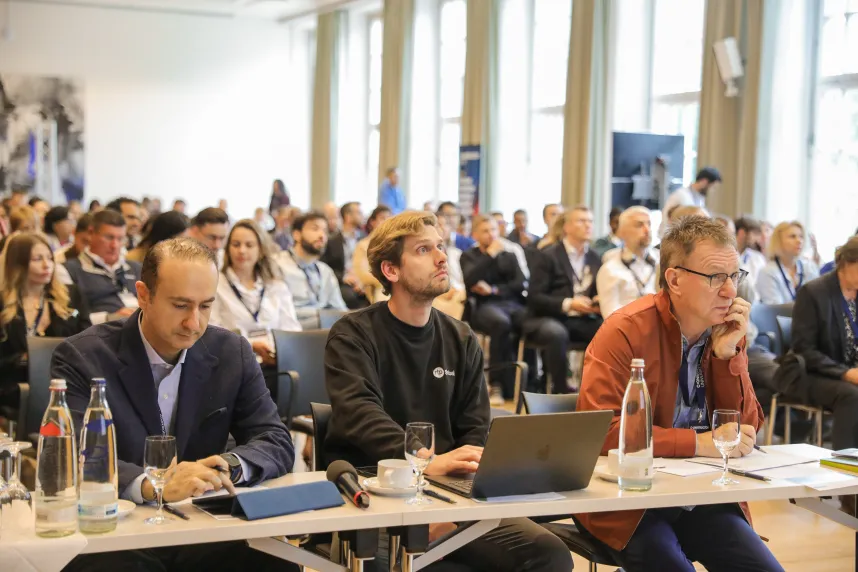
One pitch. One shot at $100,000. These are the stakes for the 14 finalist early-stage tech startups in the Constructor Start accelerator program, when they take the stage at Constructor University’s Demo Day on February 24. Last week we featured four startups with big ideas for harnessing AI to solve fundamental human problems. In part two of our three-part series, we feature five B2B startups with innovative solutions for a business world that is rapidly adapting to the new landscapes of the AI era.
After honing their business plans through an eight-week intensive curriculum with mentorship from Constructor University’s global network of business leaders, Demo Day will see each team pitch their vision live to investors, venture capital firms, media and the public for a shot at securing life-changing investment. The top team will receive $100,000 in equity-free seed funding from Constructor Capital, part of a funding pool of up to $1 million available to Constructor Start participants.
If last week’s finalists showcased how AI may reshape the human experience, this week’s startups reveal how it is evolving the way humans and machines do business together. Could one of these entrepreneurs walk away with $100,000 in funding to turn their pitch into reality? Sign up to attend Demo Day live in-person or remotely on February 24, 2026 to find out.
Demo Day Finalist Features: read part 3 of this series next.
NYX (India)
“Unleash AI creativity.” That’s what lies at the heart of NYX, the Bangalore, India-based startup and AI-powered marketing platform capable of generating both creative content and campaigns that are fully optimized to maximize ROI. NYX gives its customers access to end-to-end marketing services from a team of AI agents that span creative design, campaign planning and data analysis. By leveraging deep learning to train its AI models on large volumes of user engagement data, the platform finetunes all marketing outputs – from the design of the visual content to detailed, campaign strategy and execution – to maximize clicks and conversions.
The founders of NYX believe this ROI-first design combined with the precision and real-time adaptability of their high-powered AI agents will help them rise above the competition in the $700 billion global digital marketing industry. “NYX was born from a vision to simplify marketing and amplify results,” states the NYX website. “In a world overwhelmed by complexity, we empower brands and creators to thrive by blending the art of storytelling with the precision of AI. We create tools that transform marketing into a seamless journey where campaigns are optimized, results are amplified, and creativity knows no limits.”
Biometric Vision (Kazakhstan)
Are you human? Not so long ago, the idea of even asking this question would seem absurd. Yet, proving our humanity has become an increasingly foundational part of navigating business, society and daily life in an increasingly digital world, with AI only accelerating – and complicating – this trend. Biometric Vision is tackling the proof-of-humanity problem by using its antithesis – artificial intelligence – as a key ally.
The Kazakhstan-based startup sees a significant opportunity for reliable, adaptable and accurate proof-of-humanity solutions in business sectors where the risk of fraud is prevalent – sectors like finance and banking, payment services, insurance and gambling. Their solution combines four advanced, digital identity-verification technologies, while leveraging machine learning and AI to deliver each to the highest possible standard:
Liveness Detection: analyzes video taken by a user to verify the person is genuinely present and alive. By assessing factors like room lighting, eye and head position, it can catch fraudulent devices like masks, photos, filters and deepfakes with 98.9% accuracy.
Document verification: instantly and accurately verifies official documents like passports and government-issued identification, using optimized algorithms to provide rapid data extraction and scan multiple parameters for anomalies and fraud.
Facial recognition: the company’s Face2Face facial comparison technology is optimized for comparing passport and ID photos to user-taken selfies, accounting for appearance changes due to things like weight loss and facial hair. Biometric Vision’s algorithm ranked 37th out of over 570 worldwide facial recognition technologies on the respected NIST (National Institute of Standards and Technology) platform.
Face search: searches open sources to detect and flag wanted or blacklisted individuals and other bad actors.
AnySite (Netherlands)
This Amsterdam-based startup has turned the AI paradigm on its head by thinking of AI not as the product, but the customer. Describing itself as “the Internet for AI agents,” AnySite is a platform that turns any website into a stable, self-healing API (Application Programming Interface) capable of producing clean, structured data for any number of purposes. While APIs have become commonplace on major platforms like Reddit and PayPal, there is still up to 85% of the Internet that has no API, because the current Internet simply was not designed with autonomous agents in mind. Put simply, most websites weren’t built for AI to read, meaning unstructured content must be pulled through costly, manually intensive and unscalable scraping methods.
The founders of AnySite hope to fill this growing need with their agent-first solution that converts natural-language content into clean, structured data. “Today, agents can think and act, but they can’t see. We give them eyes,” states the company website. This structured data can then feed any number of automated or AI-powered business processes, from targeted recruitment outreach on LinkedIn, to market trend and competitor analysis, social media engagement and campaign performance, and more. The founders of AnySite believe their platform could transform the infrastructure of the Internet within the next five years and become the go-to tool for AI agents pulling structured data from the human Internet.
Fusion Cat (United Kingdom)
For every ‘win’ that the rapid adoption and deployment of AI-based business solutions deliver for a company, they also add layers of compounding complexity and discord between software and systems. This, in turn, can become very resource-intensive to manage and resolve. London-based startup Fusion Cat aims to restore clarity, coordination and scalability to backend architecture with their “cross-software communication stack,” a platform that helps complex software and AI systems communicate with each other clearly and efficiently. By allowing organizations to map all their servers, apps and data contracts automatically or manually using a simple, intuitive interface, Fusion Cat creates a single source of truth for teams, clear documentation and visual models of complex systems, and a solid foundation for code generation.
While recent advancements in AI have made it possible to deploy thousands of apps and AI components that complete millions of data transactions across services, human engineers are still largely responsible for the maintenance and security of these systems. With complexity threatening to exceed human capacity, FusionCat returns control to human engineers by equipping them with tools to effectively understand, design, build and manage even the most complex AI systems and applications. Its proprietary language generates universal code translatable into all major programming languages, allowing for quick, intuitive collaboration between human engineers and AI applications. It also tracks real-time data flow and can detect and alert users to errors, dependencies and inefficiencies.
The founders of Fusion Cat believe the future of engineering is collaboration between humans and AI, not replacement. With Fusioncat, they intend to build the tools needed to make this future a reality.
Kube-DC (Portugal)
Kube-DC is another startup helping businesses evolve and adapt their backend architecture to the incoming AI era. As AI proliferates and becomes more deeply embedded in everyday business operations, the computing power required to run these modern tools can get very expensive, very fast. Enter this Lisbon-based company, who describe their solution as a “NeoCloud Platform:” Kube-DC can transform any hardware infrastructure into a private and scalable cloud capable of managing dynamic and high-volume AI workloads at a fraction of the cost of AWS or GCP.
By shifting workloads onto dedicated infrastructure, Kube-DC says businesses can dramatically reduce computing costs while making better use of powerful hardware like GPUs—the specialized processors that fuel today’s AI boom. Instead of paying premium prices for computing capacity they don’t fully use, Kube-DC allows organizations to replace complex, multi-vendor stacks with a single software layer that transforms servers into a powerful, private cloud and allows resources to scale efficiently. Kube-DC isn't just looking to come in at a lower price, they intend to fundamentally disrupt the market with a new, more efficient economic model.
At a time when AI and data complexity is leading many enterprises to question the long-term sustainability of “cloud-first” strategies, Kube-DC is confidently betting on a hybrid future where companies reclaim ownership of their infrastructure while maintaining the agility needed to compete in an AI-driven economy. If successful, this startup could help redefine how organizations think about powering the next generation of intelligent technology.
Stay tuned for a final round of finalists...
Together with last week’s feature on four startups solving human problems, we have now featured nine of the 14 finalists in this round of the Constructor Start Accelerator Program. In our third and final installment coming next week, we’ll look at five finalists who are diving deep into solving problems in some of the most complex areas of quantum computing and DeepTech, as we build towards a Demo Day where one pitch could change everything.
Receive all updates straight to your inbox.